ARTIST IN RESIDENCE: MICHELLE CZARNECKI

ARTIST IN RESIDENCE 

Michelle Czarnecki

I really need the medium I'm working with to have its own life — something to push up against and struggle with for control.


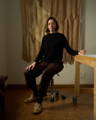
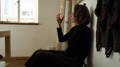
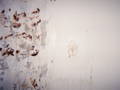
Michelle Czarnecki (b. 1984, South Africa) is a Cape Town–based visual artist. Her practice is grounded in slow, simple, and repeatable actions, and the visualisation of accumulated gestures. Working primarily with cotton and ink, she creates surfaces and objects reminiscent of organic and geological processes. Through acts of cutting, stacking, staining, and unravelling, the material is disrupted, and the surface becomes a site of negotiation between order and entropy, precision and accident. The resulting works evoke a meditative sensibility, where deep concentration and repetition give rise to complexity through the simplest of means.

After more than a decade working in the healthcare sector as a physiotherapist, Czarnecki transitioned to a full-time art practice five years ago. She recently completed Sessions, an eight-month visual arts programme in Cape Town culminating in the exhibition Waypoint (2025).

Her work has been exhibited at 99 Loop Gallery in Cape Town, as well as at the Investec Cape Town Art Fair (2026), Miart Milan (2026), and FMB Latitudes Art Fair (2026) with Whatiftheworld Gallery, with whom she is currently working towards her first major solo.


On medium

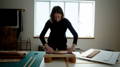
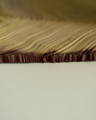
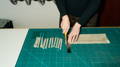
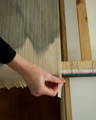
I work with 100% cotton, unbleached. Initially it was just the most accessible thing, something we all have such a close relationship with on a daily basis. It was familiar and not intimidating. I cut the cotton up into 1cm strips. Once cut, it takes on a life of its own. I'm quite particular and meticulous, so I really need the medium I'm working with to have its own life — something to push up against and struggle with for control. It's a give and take thing.

I only work with three ink colours. I'm a colour-phobe, actually. I use brown, blue, and green. What the cotton does is take on the inks; it seeps in and reacts differently depending on how much water you add. I'm drawn to the inks because it's not a direct brush stroke, and something happens when I stand back — and then I can influence it, but I'm not completely in control of it. I need to not have control of something in the process. There's also a very long drying process, which forces me to stop. I'll ink late in the day, leaving myself a little something to be excited about the next day.


The inking and the painting are a space of childlike fun for me. I'll never show it to anybody in that format. I cut the work up into a million little pieces and reassemble them. There's a whole painting hidden within the work.


On process

I've set myself up where I'm not directly influencing the work at any given point. There's not a point in the whole making where I can draw a line and have that line be there in the end. With the ink I have very little control, but when I'm cutting I'm in complete control. There's a defiance in the way I've been living. I think I grew up very mainstream — this is how the world works: you study, you get a job, you start a pension, you follow the steps. And as much as I have one foot in the real world, it never feels quite right to me. Because art started out being inconsequential in a way, that helped me to not bring that other world into the studio.


My work is not predetermined; I can't work that way around. I've tried, and there's so much resistance from my thoughts, my body — everything resists. It's interesting because this is completely in contrast to how I am as a person in my daily life. I overthink in my normal life all the time, and I'm very sensitive to noise and people's energies around me. The studio, these walls — the minute I'm in here, I don't think, I let all of that go. I just do, and my body knows what to do, and I try to surrender to that.


I'm really curious, and I feel like because I haven't learnt formal skills, I'm just going to experiment until something interesting happens — and that's kind of how I see myself as an artist. If you sit with anything long enough, something interesting is going to happen, but you have to be willing to show up and play and experiment. And it helps if your tools are not precious or expensive.

Nature and geology

I think these three colours are linked to nature. For me, the natural world is everything; that's where we go for solace or reprieve. When you're in the city, you're always yearning to be up the mountain or in the forest somewhere. I speak a lot about geological layers and things like that, just because visually I'm drawn to those things, but it also represents things that take time — things that are real, not here today, gone tomorrow. And that's part of the reason I like to cut the strips. I like to spend time; I love the meditation of working slowly and meticulously and repetitively.


The way the ink or the water seeps into the fabric — it kind of puddles underneath, then I'll move it, and it flows this way or that way. I often think about how that relates to when I have my hanging works up; there is almost a reminder of fluidity and movement.

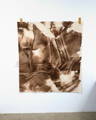
If you look at a rock, you see the edge and you see the lines, and you maybe see something that happened in history, but you never see the layers — and there's no way of seeing that much time in one go. This relates to the mountain work I made at Krone: it's multiple images, snapshots layered together in a way. I really like that idea — how you can, for a second, see everything at once.


I love to peruse Google Earth, and I find it absolutely fascinating how, at any given moment, just seeing where you are from above changes your whole mindset. And then, at the same time, if you pick up a leaf and put it under the microscope, and put the two together, they can look the same — how is that possible?

The role of gravity

I create from a space of experiment. What would happen if we do it this way? How might that look — the unpredictable factor — movement and gravity. It kind of snuck up on me, and it was not planned. I always wanted to have an almost sculptural element to my work. I want it to be loose and soft, and a little bit untamed, but at the same time a little structured. When I started out with those, I would glue the whole back section solid, but then I wanted to see what would happen if I used less and less adhesive. Where are things going to start falling apart? What is the least amount of structure I have to give to hold it up? I've never been able to work vertically on a wall; I wouldn't be able to do any of the ink work like that — it would be way too direct for me. I think because I'm working on a horizontal surface when I'm cutting or doing the inking, things reveal themselves when I lift the piece up. I want to be surprised by the work.


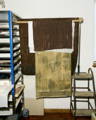
With some pieces, the images stack, so you see the cotton strips from the side, and the image is hidden. Whereas when I'm working on a frame — a loom — I overlap the strips halfway, so you have a glimpse of the image beforehand, before I cut it. And as you start assembling them, it compresses everything. I'm interested in distorting the image a little bit.


I hope that the time it takes to make the work transfers to the viewer’s experience — some kind of encoded slowing of time.

On time

I'm always hyper-aware — I can't not hear what's happening around me right now. I'm aware of your energy and how everyone's feeling and what the weather is; I'm just tuned into everything, and I struggle to switch certain things off. When I come to the studio, the minute I walk in here — I've already thought about what I'm going to do today — and the minute I start, everything just goes quiet. There's a feeling of time slowing down. I think this is linked to repetition. The satisfaction of visually seeing what you've done. Instead of killing time, I feel like I'm accumulating time.


I've always been drawn to artwork where it's evident how much time has been spent on something. I think it ties back to the natural world — I'm drawn to rock formations and really old, gnarled trees. There is something about a piece of wood where you can see that something happened there; you can't recreate that in an instant. I hope that the time it takes to make the work transfers to the viewer's experience — some kind of encoded slowing of time.


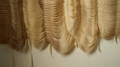
The work has the sense that it is almost starting to decompose and fall apart, and it can look quite precarious, so there's that fragility to it. I love it when people feel the urge to touch the work, to be curious, to slow down and try to understand its construction.


This natural unravelling of the cotton threads almost feels like the pieces have been through something — something has happened here. Every time I need to take it up and take it down, or stow it away, that usually happens naturally, and if it doesn't, I will help it along a little bit — a little brush here, a little tweak there. The appearance of decaying, like a patch of mould growing on something, like water sitting out for too long, and debris falling, and how the sediment would settle naturally in things — I think visually I'm drawn to all of those things, which relate back to time, and how it plays out in nature.


The Port of Cape Town

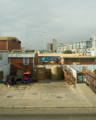
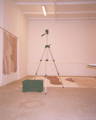
My studio is a small space in an old building just inside the Port of Cape Town. The window sits right at the point where trucks exit the port, so the backdrop to most of my days is the movement of giant container ships — cranes hoisting them off vessels and onto the backs of flatbed trucks. If I leaned out, I could probably touch one.


Outside my window there's an intersection where trucks gear down to brake, so I'm surrounded by revving engines, industrial noise, and the shriek of seagulls. The constant sound of trucks, generators, and pumps vibrates the whole building. I've always struggled with loud noise, but it's become a strangely comforting backdrop to my days in the studio — it just feels right now.


I have a view of the cruise terminal, and every single day looks different. You never know what's going to be moored outside, and I find myself imagining where each ship came from, or where it's headed next. It's a noisy, energetic space — and somehow I found complete quiet in the middle of it. I enjoy the contradiction between the heavy industrial labour around me and the soft, fragile materials I work with.

 The backdrop to most of my days is the movement of giant container ships. If I leaned out, I could probably touch one

A message left behind

When I walked into the studio at the Krone residency for the first time, there was a little clock painted on the wall. I don't know who made it. But it was like a little message saying, "Just take your time." There's no sentence more comforting than "take your time." Immediately I felt okay, we're good — take your time, even if you make one thing.

Assimilation

I knew it would be hard for me to adjust to the space because I'm very sensitive. Even if we go away for the weekend, it takes my body a moment to realise where I am. Because my space is so small, I was very curious to know what would happen. I moved things around a lot to settle in. In the past, I would have been annoyed by how much time I would spend setting up, but now I know that is a prerequisite, so I just got on with it. Shifting things around, figuring out which space gets the sun in the afternoon, where I can do quiet, meticulous work. What space can I heat up? Where can I make a mess?


This residency took place just a couple of months before my first solo exhibition at Whatiftheworld Gallery. Going into it, I thought it might have quite a big impact on the exhibition, but I didn't want to arrive there carrying too much pressure to produce. I went in wanting to stay open, and — because of the space — to play specifically with scale. It's interesting to look at the work I made before and after the residency: for me, there's a definite shift that came from working in a different environment.

Twee Jonge Gezellen

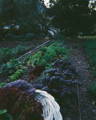
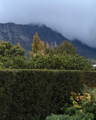
Twee Jonge Gezellen is such a nourishing environment, those mountains, the garden. Baskets of vegetables from the garden, and eggs from the chickens at the back. I felt my needs were taken care of and I could really just sit with my work. I had a little bird, Frank, that used to come into the studio every single day. In the month that I was there, the biggest part of the colour change of autumn occurred. Almost every day the colours of the trees would be different.


I adapted to the rhythm of the farm completely. I'm an early bird already, but I found myself in the studio at seven at the same time everyone starts on the farm, and I would work until five, with my little lunch break. I was really productive, actually. I'm in the studio in town, I'm kind of done by two o'clock, I think just being in the city, my energy gets drained a little bit faster. Whereas on the farm, I found I had a lot more stamina.

Daily paintings

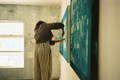
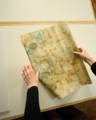
I set out to do a painting a day during the residency. I cut all the fabric before arriving so if nothing else, I was going to paint one thing every day, and see what happens. I decided to paint a mountain a day and I ended up with 24, because, out of the 39 days, there were only 24 days that I could see the mountains — my inherent parameter. I cut them up and stuck them together. You can see an undulation of the mountainscape, day to night — day to night — cloud cover, distance and proximity. The crescendos are evident, but you really have to look to see them. It's encoded with time and my experience at the residency. On days that I was stuck, I just painted the mountain for the day — and this brought me so much joy.

On solitude

I don't mind being alone — one needs to be alone to work. One or two people warned me about how loneliness can set in. There was a big storm, the weather was changing, and I found it really interesting that it brought up some things. One of the biggest things was: yes, you do really need community, it's very important. I think just physically checking in with human beings is actually important. The other thing it brought up was that I'm really hard on myself. I think because I didn't have my usual schedule, the people you bump into, or family to go home to — things that normally buffer that and break the cycle weren't there, so alone it continued through the night. For me, it was quite eye-opening.

 PHOTOGRAPHY AND VIDEOGRAPHY:

JONATHAN KOPE


MICHELLE CZARNECKI

(Residency images)


CREATIVE DIRECTION:

HOICK


This website uses cookies. By continuing
to use it you accept our use of cookies.